Surge Protection Commercial Broward County: An IEC 62305-4 Guide for Data and Business Infrastructure
Broward County sits in the heart of Florida’s lightning corridor — and its commercial infrastructure bears the full weight of that exposure. From the Fort Lauderdale financial district and Port Everglades to the colocation data centers serving South Florida’s growing technology sector, the commercial facilities operating across Broward County depend on electrical continuity the way manufacturing depends on supply chains. Surge protection for commercial Broward County is not a commodity purchase — it’s an engineered system requirement, and the international standard that defines it is IEC 62305-4.
Why Broward County’s Commercial Infrastructure Is High-Risk
Florida averages more lightning strikes per square mile than any other state, and South Florida’s geography — ocean air masses colliding with inland heat — produces some of the most intense and frequent thunderstorm activity in the country. Broward County’s commercial exposure compounds that baseline risk in specific ways.
Dense electrical infrastructure. The Fort Lauderdale central business district, Cypress Creek corporate corridor, and Dania Beach technology parks operate dense concentrations of electronic systems — trading platforms, ERP systems, POS networks, VoIP infrastructure, and security systems — all connected to aging commercial electrical distribution that may have little to no coordinated surge suppression in place.
Port Everglades logistics operations. As one of the busiest cruise and cargo ports in the United States, Port Everglades runs continuous operations across terminal facilities, crane systems, cold storage, and customs technology infrastructure. A surge event affecting port operations doesn’t just damage equipment — it disrupts international logistics chains.
Colocation and data center density. Broward County hosts a growing concentration of colocation facilities serving South Florida’s financial, healthcare, and government sectors. These facilities operate under uptime SLAs that make any unplanned downtime a contractual and financial event, not just an inconvenience.
Utility infrastructure vulnerability. South Florida’s power grid, while robust, is exposed to the same lightning activity that threatens the buildings it serves. Utility-borne surges — transients that travel into a building through the service entrance from the utility side — are among the most damaging and least understood surge pathways for commercial facilities.
What IEC 62305-4 Requires for Commercial Data Protection
IEC 62305-4 is the international standard specifically governing the protection of electrical and electronic systems within structures from lightning electromagnetic impulse (LEMP). While the American market commonly references NFPA 780 for structural lightning protection and IEEE/UL standards for surge protective devices, IEC 62305-4 provides the most comprehensive framework for protecting data systems, signal infrastructure, and electronic equipment inside commercial buildings.
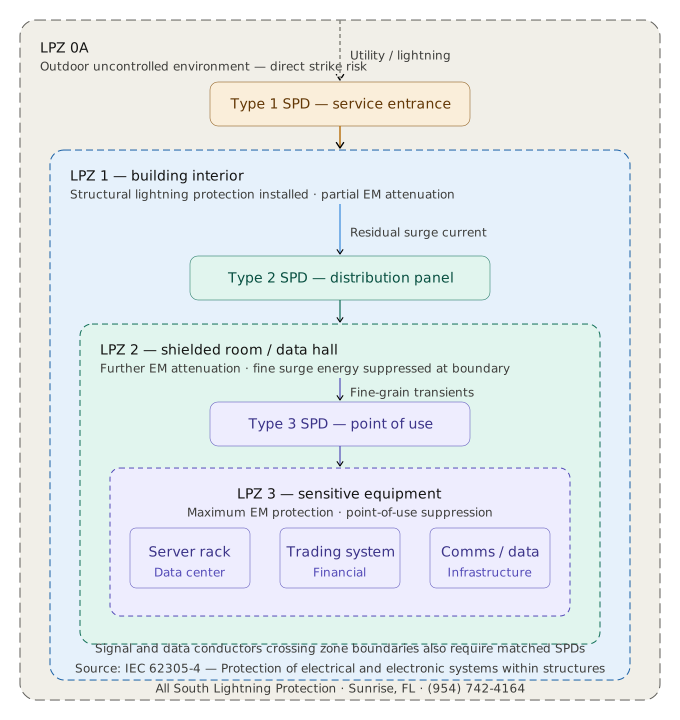
The standard defines a zoned protection approach — Lightning Protection Zones (LPZs) — that determines where and what type of surge protection is required based on a system’s electromagnetic environment and sensitivity to transients.
LPZ 0: The uncontrolled outside environment — direct strike risk, full unattenuated electromagnetic field. Rooftop equipment, outdoor antenna systems, and service entrance conductors exist in this zone.
LPZ 1: The interior of a structure with a compliant lightning protection system installed. The electromagnetic field is partially attenuated, but surge currents on conductors crossing the zone boundary must be suppressed at the crossing point.
LPZ 2 and beyond: Progressively more protected interior zones where sensitive electronics are located. Each zone boundary crossing requires an appropriately rated SPD to prevent residual surge energy from reaching equipment at the next level.
For a commercial facility in Broward County — whether a financial services office in Fort Lauderdale, a logistics operation at Port Everglades, or a colocation data center in Sunrise — implementing IEC 62305-4’s zoned approach translates directly into the Type 1/Type 2/Type 3 SPD cascade that defines a complete surge suppression system.
Single-Stage Surge Protection vs. a Complete SPD System: What Broward County Businesses Get Wrong
This is the most important distinction in commercial surge protection — and the one that costs Broward County businesses the most money when they get it wrong.
Single-stage protection means one surge protective device installed at one point in the electrical system, typically a panel-mounted unit at the main distribution board or a plug-in device at a specific piece of equipment. Single-stage protection handles some surge energy at that one point, but it cannot fully suppress a high-energy strike event, and it does nothing to protect equipment that connects to the building through data cabling, communication lines, or signal circuits. For a commercial office with a few workstations, single-stage protection may reduce losses. For a data center, financial trading operation, or logistics facility, it is inadequate.
A complete SPD system — the only approach that aligns with IEC 62305-4 and IEEE cascade protection recommendations — deploys coordinated surge suppression at every zone boundary in the facility’s electrical and signal infrastructure.
Type 1 SPD at the Service Entrance
The Type 1 device is installed at or before the main service entrance disconnect, on the line side. It is rated to handle the highest-energy events — direct strike coupling and full utility-borne surges. For a large commercial facility in Broward County, this unit needs to be rated in the 100kA to 200kA range per phase. Without a Type 1 device, every downstream system is fully exposed to the initial surge event. This is the device that protects your entire facility from what comes in from outside.
Type 2 SPD at Distribution Panels
Type 2 devices are installed at every sub-panel serving a distinct area or system — the panels for the server room, the trading floor, the communications closet, the HVAC, and building systems. These units absorb the residual surge energy that the Type 1 device didn’t fully clamp. In a multi-floor commercial building or a facility with dedicated IT distribution infrastructure, Type 2 protection at every sub-panel is not optional — it’s what keeps the cascade effective. Our commercial surge protection services cover full Type 1/2/3 system design and installation across Broward County facilities.
Type 3 SPD at the Point of Use
Type 3 devices are installed at or immediately adjacent to individual loads — the server rack, the UPS system, the communications switch, the workstation cluster. These units handle the lowest-energy but highest-frequency transients: the internal switching events, the residual energy from near strikes, and the fine-grain voltage fluctuations that accumulate over time and degrade electronic components even when they don’t cause immediate failure. For colocation facilities and financial services operations in Broward County, Type 3 protection at every rack and critical circuit is what the IEC 62305-4 framework ultimately requires at the innermost protection zone boundary.
Data and Signal Surge Protection: The Missing Layer
Power surge protection alone is not complete protection. In any commercial facility with networked infrastructure — which is every commercial facility in Broward County — data and signal lines represent equally dangerous surge pathways.
Ethernet cabling, fiber with copper components, coaxial runs, telephone lines, security system wiring, and CCTV cabling that connects equipment in different parts of a building — or that runs between buildings — can all carry destructive surge currents directly to sensitive electronics even when the power system is fully protected. IEC 62305-4 explicitly addresses this: every conductor crossing a lightning protection zone boundary must be protected, regardless of whether it carries power or signal.
Data surge protection devices are matched to the specific signal type and application — RJ45/Cat6 for network connections, BNC for CCTV, coaxial for cable and antenna systems, RS-485 for building automation, and specialized protection for serial and analog control circuits. The selection and installation of these devices requires the same engineering rigor as power SPD specification, and the same cascaded zone-boundary logic applies: protection must be present at every crossing point, not just at the most obvious entry point.
For Broward County’s colocation data centers, financial services firms, and Port Everglades logistics operations, data and signal surge protection is not an add-on — it is a core infrastructure requirement.
Fort Lauderdale Financial District, Port Everglades, and Colocation Facilities: Specific Risk Profiles
Fort Lauderdale Financial Services
The financial services firms operating in the Fort Lauderdale CBD and Cypress Creek corridor run trading platforms, client database systems, regulatory compliance infrastructure, and real-time communications that cannot absorb unplanned outages. Data corruption from a surge event — even one that doesn’t destroy hardware — can trigger regulatory issues, client data integrity failures, and business continuity plan activations that cost far more than a properly engineered SPD system. IEC 62305-4 compliance is increasingly referenced in financial services technology RFPs and audit frameworks because regulators understand that infrastructure reliability begins at the physical layer.
Port Everglades Terminal Operations
Port Everglades operates crane systems, terminal automation, cold storage controls, customs and CBP data systems, and vessel scheduling infrastructure across a facility that sits directly exposed to Broward County’s storm environment. A surge event affecting crane controls, cold storage monitoring, or customs processing creates immediate operational and economic disruption that cascades far beyond the port itself. The facility’s geographic exposure — elevated, coastal, with extensive overhead conductors — makes it one of the highest-risk commercial surge environments in South Florida.
Broward County Colocation Data Centers
Colocation facilities serving South Florida’s healthcare, financial, and government sectors operate under SLAs that guarantee 99.999% uptime. The power and data surge protection infrastructure supporting those SLAs must be engineered to IEC 62305-4 and IEEE standards, not assembled from commodity surge strips and single-stage panel devices. A colocation operator whose facility suffers preventable surge-related downtime faces SLA penalties, customer attrition, and reputational damage that no equipment replacement budget can recover.
Grounding, Bonding, and the Foundation of Any Surge Protection System
No SPD system performs as designed without a properly engineered grounding and bonding foundation. This is a point that commercial facility managers in Broward County frequently overlook when specifying surge protection.
The effectiveness of every Type 1, Type 2, and Type 3 device in a cascade system depends on its ability to divert surge energy to a low-impedance ground path. An SPD installed on a system with high ground impedance, unbonded ground references, or isolated ground rods — a common mistake in commercial facilities where different contractors have installed different systems over time — will not perform to its rated specification. Ground potential rise during a surge event can actually make an improperly grounded SPD installation more dangerous than no SPD at all.
For any Broward County commercial facility evaluating surge protection, a ground testing and bonding assessment should precede SPD specification. Our grounding and bonding services provide the verified foundation that makes a Type 1/2/3 SPD cascade work as designed. This is especially critical for older commercial buildings in Fort Lauderdale and Port Everglades terminal facilities, where ground systems may never have been formally tested.
Frequently Asked Questions
What is IEC 62305-4, and does it apply to my Broward County business?
IEC 62305-4 is the international standard for the protection of electrical and electronic systems inside structures from lightning electromagnetic impulses. It applies to any commercial facility with networked electronic infrastructure — which includes virtually every business in Broward County. While it is an international standard rather than a U.S. code requirement, it represents the most comprehensive technical framework for data and signal surge protection and is increasingly referenced in commercial facility specifications and technology procurement.
What’s the difference between a surge protector and an SPD system?
A surge protector — the kind you buy at a hardware store — is a single-stage, single-location device. It provides some protection at one point in the circuit. An SPD system is a coordinated, multi-tier architecture that suppresses surge energy at every zone boundary in the facility’s electrical and signal infrastructure: Type 1 at the service entrance, Type 2 at distribution panels, Type 3 at point-of-use loads, and matched data/signal protectors on every communication conductor. Only the system approach aligns with IEC 62305-4 and IEEE cascade protection standards.
How often should commercial surge protection systems be inspected in South Florida?
Given Broward County’s lightning exposure, annual inspections are the minimum. Inspections should also be conducted after any known direct strike event affecting the facility or nearby utility infrastructure. SPDs are sacrificial devices — they absorb surge energy and degrade over time. An SPD that has absorbed significant events may test as functional but be operating below its rated clamping specification.
Does my facility’s UPS system provide surge protection?
UPS systems provide battery backup for outages but are not designed to suppress high-energy surge events. A lightning-induced surge can damage a UPS system itself, and any surge energy that passes through a UPS reaches the connected load. UPS infrastructure should be protected by upstream SPDs, not treated as a surge protection solution.
Can surge protection be added to an existing commercial facility without major electrical work?
Yes. Type 1 and Type 2 SPDs are typically installed by a licensed electrician with minimal disruption to facility operations. Point-of-use Type 3 devices and data/signal protectors can usually be installed without any electrical shutdown. For large facilities, installations are typically phased by area or system to minimize operational impact.
Work With Broward County’s Commercial Surge Protection Specialists
All South Lightning Protection operates a Sunrise, Florida location specifically serving Broward County’s commercial, industrial, and data infrastructure clients. Our team designs and installs complete IEC 62305-4-aligned surge suppression systems — from service entrance Type 1 devices through full data and signal protection stacks — for the Fort Lauderdale financial district, Port Everglades, and the colocation and technology facilities across Broward County.
Every installation includes a verified grounding and bonding assessment, coordinated SPD specification, and the documentation your facility needs to demonstrate compliance with applicable standards. Review our commercial project portfolio to see completed installations across Florida’s most demanding commercial environments.
Single-stage protection leaves your Broward County business exposed. A complete SPD system doesn’t.
Call All South Lightning Protection’s Sunrise office at (954) 742-4164 to schedule a commercial surge protection assessment for your Broward County facility.