Florida Mandates Lightning Protection on New K-12 Buildings — Here’s Where Tampa Schools Are Still Exposed
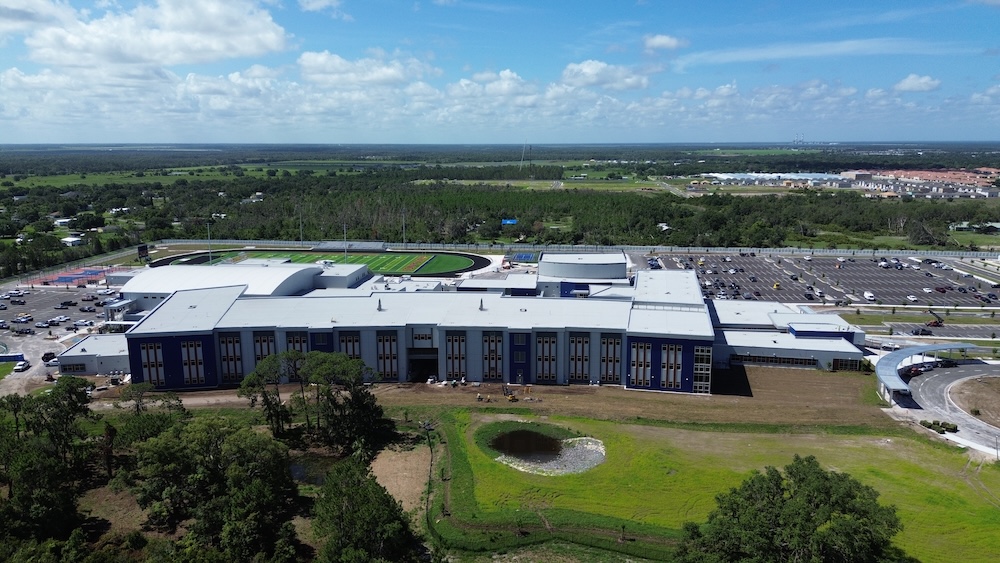
Florida law requires NFPA 780-compliant lightning protection on every new K-12 school building in the state. That mandate is not discretionary, and it is not new. What is new — and what keeps coming up in conversations with Hillsborough County facilities directors — is the gap between what the code covers and what it doesn’t. The mandate applies to new construction. It says nothing about the portable classrooms added three budget cycles ago, the press box that went up last spring, or the 40-year-old gymnasium where students shelter during afternoon storms. Those structures sit outside the mandate’s reach, and outside any certified protection system, unless the district acts on its own. In a state that records more than 1.4 million cloud-to-ground lightning strikes per year, that gap is a liability problem before it is ever a safety one.
What Florida’s NFPA 780 Mandate Actually Requires — and What It Leaves Out
Florida adopted NFPA 780 as the governing standard for lightning protection on new commercial and institutional construction, including K-12 schools. The 2026 edition of NFPA 780 defines a complete system as five interdependent components: air terminals, down conductors, a grounding electrode system, equipotential bonding, and surge protective devices (SPDs). Every one of those components must be present and correctly sized for the system to function as designed. A building with air terminals and no bonding is not a protected building — it is a building with copper on the roof.
The mandate’s scope, though, stops at new construction. Renovations that trigger a building permit may bring older structures into compliance review, but a district that simply maintains existing buildings — even buildings that have never had a lightning protection system — faces no automatic code trigger. That means a significant portion of Tampa-area school inventory operates without any certified system at all. Hillsborough County alone has more than 250 schools and support facilities. The ones built before Florida’s adoption of NFPA 780 requirements, or built under earlier editions that have since been superseded, are not grandfathered into compliance. They are simply unprotected.
Portable classrooms are the most common exposure point. They are typically bonded to nothing, grounded to nothing, and positioned in open areas that make them among the most vulnerable structures on any campus. The NFPA 780 standard does address temporary and relocatable structures, but enforcement at the district level is inconsistent. If your district has portables and no documented lightning protection plan for them, that is the first conversation to have with your facilities team.
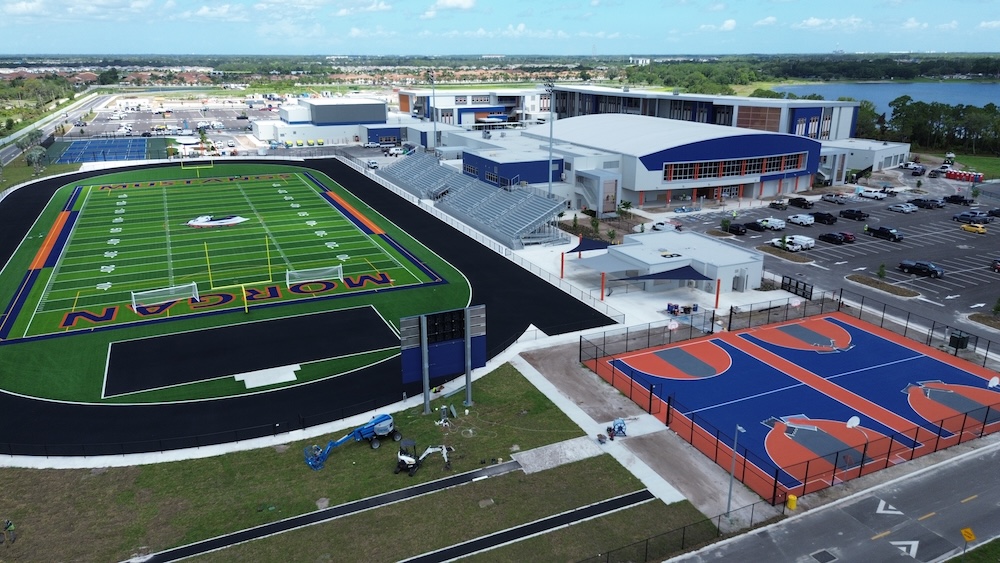
Athletic Fields: The Highest-Risk Location on Any Florida Campus
The afternoon thunderstorm pattern in central Florida is one of the most predictable weather phenomena in North America. Between June and September, convective storms develop over the peninsula almost daily, typically between 2:00 and 6:00 p.m. — exactly when after-school athletic practice is underway. Florida averages more than 100 thunderstorm days per year in parts of the state, and the Tampa Bay region sits near the center of what the National Weather Service identifies as the highest lightning-density corridor in the United States.
Students on open athletic fields have no natural shelter. A lightning bolt carrying 40,000 amperes or more does not need a direct strike to injure or kill — ground current spreading from a nearby strike point can incapacitate anyone within 60 feet of the strike location. Side flash from a nearby tree or fence post is a documented cause of field injuries. The Lightning Protection Institute recommends a minimum 30-minute delay after the last observed lightning before resuming outdoor activity, but that protocol only works if someone is monitoring conditions and has authority to clear the field. Many districts have the policy. Fewer have the infrastructure — warning systems, designated shelter routes, and hardened shelter structures — to execute it reliably.
Press boxes, scoreboards, light poles, and dugout structures are all elevated metallic objects on open ground. Without proper grounding and bonding, each one is a potential side-flash source. A press box with a metal roof and no down conductors is not shelter — it is a Faraday cage with no path to ground, which means any strike energy that enters the structure has nowhere to go except through the people inside it.
How a Complete K-12 Lightning Protection System Is Designed
NFPA 780 uses the Rolling Sphere Method — a 150-foot sphere rolled across the building model — to identify unprotected zones. Any point the sphere touches without first contacting an air terminal is a gap in coverage. This replaced the old 45-degree cone-of-protection model, which is no longer recognized by the standard. If your school’s system was designed under the cone method and has not been recertified, the coverage map is wrong.
Air terminals on school buildings are typically installed at roof ridges, parapets, and mechanical equipment platforms. The terminals themselves should be moderately blunt — NFPA 780 specifies this explicitly, because a sharply pointed rod actually ionizes the surrounding air more aggressively, which can increase strike probability rather than reduce it. Down conductors run from the air terminals to the grounding electrode system, sized by building class: Class I buildings under 75 feet require conductors of at least 57,400 circular mils of copper; Class II buildings over 75 feet require 115,000 circular mils. Most Tampa-area school buildings fall into Class I, but multi-story structures and gymnasiums with high roof profiles may qualify as Class II.
The grounding electrode system must achieve a resistance to earth of less than 25 ohms, with bonding connections between the lightning protection ground and the building’s electrical grounding electrode system held to 1 ohm or less. NEC 250.106 requires that the lightning protection grounding system bond to the building’s electrical ground — they cannot be independent systems. NEC 250.60 governs how lightning protection electrodes relate to the building grounding electrode system. Getting this wrong is the most common installation error we see on school campuses that were protected by contractors without specific lightning protection credentials.
SPDs complete the system. A Type 1 device at the service entrance handles direct-strike energy. Type 2 devices at distribution panels protect downstream circuits. Type 3 devices at point-of-use locations — computer labs, server rooms, AV equipment — handle residual transient energy. All three tiers are required for a complete system. A power strip with a built-in surge protector is a Type 3 device. It provides no meaningful protection against a direct strike or a near-miss event without Types 1 and 2 upstream.
Faraday Systems on Tampa School Campuses: What They Are and When They Apply
All South has installed Faraday-based lightning prevention systems at multiple Tampa-area school campuses, including Floral City Elementary, Delores Parrot Middle, and Deep Creek Elementary. A Faraday system — sometimes called a Faraday preventor — uses a mesh of conductors across the roof plane to create an equipotential surface that suppresses the upward leader formation that precedes a lightning attachment. The system does not attract lightning and redirect it; it works by reducing the probability that the protected structure becomes the attachment point in the first place.
Faraday systems are particularly well-suited to school buildings because they protect the entire roof plane rather than relying on the geometric coverage of individual air terminals. For flat-roofed structures — common in Florida school construction — the mesh approach eliminates the coverage gaps that the Rolling Sphere Method sometimes reveals between terminal placements. They are also compatible with rooftop HVAC equipment, solar arrays, and communications infrastructure, all of which are increasingly common on school buildings and all of which create new exposure points that a traditional rod-and-cable system may not adequately address.
Learn more about how Faraday preventor systems work and where they are appropriate for your facility type.
UL 96A Certification: The Document Your Risk Manager Needs
A lightning protection system that was installed correctly but never certified is a system that cannot be verified. Underwriters Laboratories issues UL 96A certificates for complete lightning protection systems that have been inspected and found to meet the installation standard. The certificate is valid for five years. After five years — or after any modification to the building that affects the system, including a reroof, a rooftop equipment addition, or a structural change — the certificate must be renewed through a new UL inspection.
For school districts, the UL 96A certificate serves several functions. It documents due diligence for risk management and insurance purposes. It provides a baseline for the five-year inspection cycle required to maintain certification. And it gives the district’s facilities director a defensible record that the system was installed to a recognized national standard — which matters when a claim is filed or when a parent’s attorney asks what the district did to protect students.
If your school has a lightning protection system but no UL 96A certificate on file, schedule an inspection and recertification before the next storm season. If the system was installed more than five years ago without a renewal inspection, the certificate has lapsed — and so has the documented protection.
What a Site Assessment Covers for a K-12 Campus
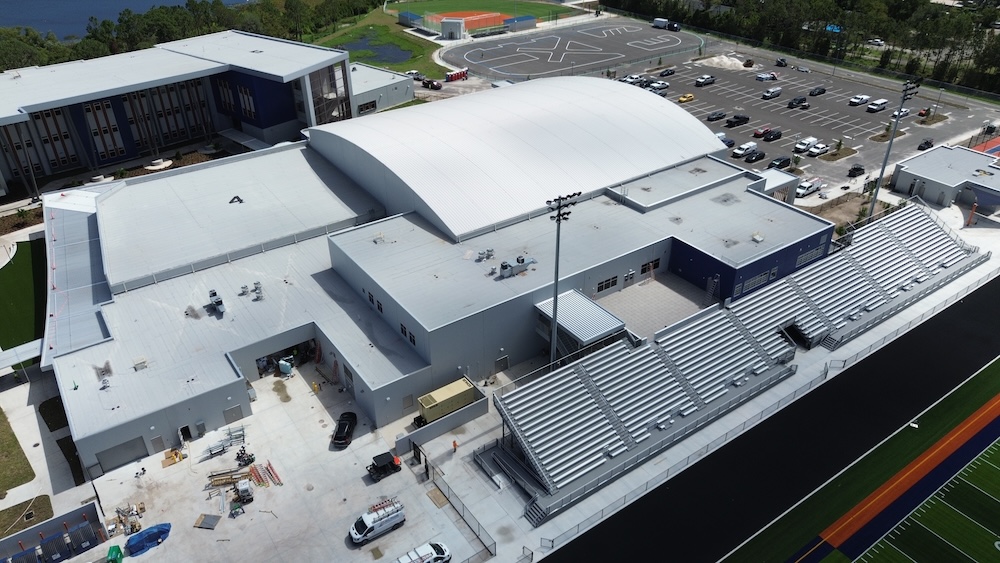
A proper site assessment for a school campus is not a roof walk with a clipboard. It covers the entire property: main buildings, gymnasiums, portable classrooms, athletic facilities, press boxes, scoreboards, light poles, perimeter fencing, and any rooftop equipment added since the last system review. The assessor maps existing air terminal locations against the Rolling Sphere Method to identify coverage gaps, checks conductor sizing against the current NFPA 780 edition, measures ground resistance at each electrode, and verifies bonding continuity between the lightning protection system and the building’s electrical grounding electrode system.
The output is a written report with findings, a gap analysis, and a prioritized remediation plan. For districts managing multiple campuses, the report gives the facilities director a ranked list of exposures — which buildings have no system at all, which have systems that are out of certification, and which have systems that are compliant and current. That ranking drives the capital planning conversation with the superintendent and the school board.
All South provides CAD drawings and sealed engineering documents for permit-ready installations, which matters for districts that require board approval before construction work begins. See our completed education projects for examples of the scope and scale of work we have done on Florida school campuses.
Frequently Asked Questions
Does Florida law require lightning protection on existing school buildings, or only new construction?
Florida’s NFPA 780 mandate applies to new K-12 construction. Existing buildings are not automatically required to retrofit unless a renovation triggers a permit that brings the structure into current code review. That said, the absence of a legal mandate does not eliminate liability exposure. A district that is aware of an unprotected building and takes no action has a harder time defending a negligence claim than one that has documented its assessment and remediation plan. Many districts in Hillsborough and surrounding counties are proactively retrofitting older buildings for exactly this reason.
Are portable classrooms covered under the school lightning protection mandate?
NFPA 780 addresses relocatable structures, but enforcement at the district level varies. Portable classrooms are among the highest-risk structures on a school campus — they are typically ungrounded, unprotected, and positioned in open areas. A portable classroom with no lightning protection system and no bonding to the campus grounding electrode system is not a safe shelter during a storm. Districts should treat portables as a priority item in any campus lightning protection assessment, regardless of whether the code formally requires it.
How often does a school’s lightning protection system need to be inspected?
UL 96A requires a full inspection and recertification every five years to maintain a valid certificate. Beyond that cycle, NFPA 780 recommends inspection after any event that may have affected the system — a direct strike, a significant storm, a reroof, or the addition of rooftop equipment. In practice, we recommend an annual visual inspection by a qualified contractor to catch mechanical damage, conductor corrosion, or grounding electrode degradation before it becomes a system failure. Florida’s coastal environment accelerates corrosion on copper conductors and ground rods, so the five-year cycle is a minimum, not an optimal interval.
What is the difference between a Faraday system and a standard NFPA 780 rod-and-cable system for a school?
A standard NFPA 780 system uses discrete air terminals positioned to provide Rolling Sphere Method coverage, connected by down conductors to a grounding electrode system. A Faraday system uses a continuous mesh of conductors across the roof plane to create an equipotential surface that suppresses upward leader formation. Both approaches are compatible with NFPA 780 and UL 96A certification. The Faraday approach is particularly effective on flat-roofed school buildings with multiple rooftop penetrations — HVAC units, exhaust fans, communications equipment — because the mesh provides continuous coverage without relying on terminal placement geometry. All South has installed Faraday systems at several Tampa-area school campuses and can assess which approach is appropriate for a given building type.
Can a school district get a single UL 96A certificate for all campus buildings, or does each building need its own?
Each structure requires its own UL 96A certificate, because the inspection and certification process is building-specific. A gymnasium, a main classroom building, and a portable classroom cluster are each assessed and certified independently. For a district managing dozens of campuses, this means maintaining a certificate inventory that tracks the certification date and renewal deadline for every protected structure. All South can help districts build and maintain that inventory as part of an ongoing service relationship, which simplifies the five-year renewal cycle and ensures no certificate lapses unnoticed.
Schedule a Campus Assessment Before the Next Storm Season
The afternoon storm window in Tampa opens in June and runs through September. That gives districts a narrow planning window — late winter through early spring — to complete assessments, approve budgets, pull permits, and finish installations before students are back on athletic fields in the heat of storm season. A campus assessment typically takes one to two days for a standard K-12 facility. The written report and gap analysis follow within a week. From there, a straightforward installation on a single building can be completed in days; a multi-building campus with portables and athletic facilities may take two to four weeks depending on scope.
All South Lightning Protection has worked with Tampa-area school districts for decades. We have installed and certified systems at Floral City Elementary, Delores Parrot Middle, Deep Creek Elementary, and MOSI, among others. We provide permit-ready CAD drawings, sealed engineering documents, and UL 96A certification support from start to finish. Our grounding and bonding work meets NEC 250.106 and 250.60 requirements, and our surge protection installations cover all three SPD tiers required for a complete system. For more on what a complete system costs and how to build the capital case for your school board, see our lightning protection cost guide.
If you are a Hillsborough County facilities director, a district risk manager, or a superintendent preparing a capital budget request, schedule a campus site assessment with All South now — before the storm season makes the decision for you.