After Three Lightning Fires, FOX 13 Turned to All South for Answers — Here’s What We Told Them
Last week FOX 13 came to our Tampa warehouse with the question every homeowner in this state has been asking since August. Three buildings in the Bay Area burned after lightning strikes in three weeks. So what can I actually do about my house?
Chuck Voight, our Senior Executive Vice President, gave the short answer on camera. This is the long one: what lightning rods on a house actually do, what they cost, what your homeowners insurance will and will not do for you, and what to ask before you hire anyone.
Do lightning rods on a house really work?
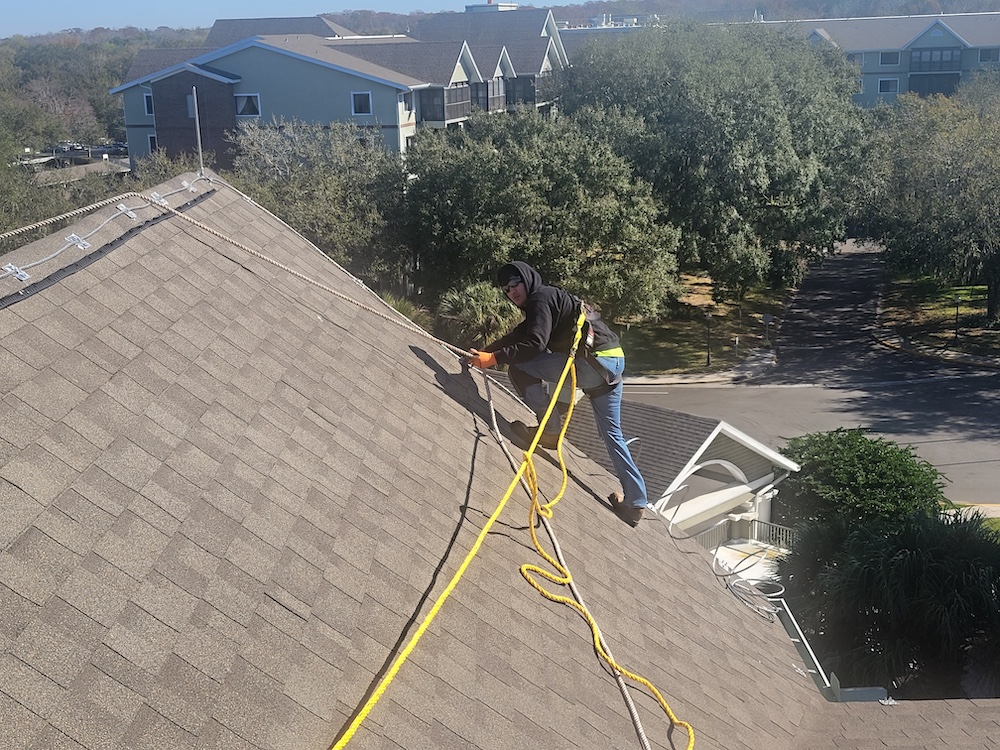
Yes, and the reason is simpler than most people expect. A strike will hit something on your property. Lightning rods on a house decide what it hits and where the energy goes afterward. Done right, the strike lands on a rod, travels down a copper cable on the outside of the house, and goes into the ground. Your shingles, your attic, your wiring, and the people asleep inside never meet it.
A rod does not attract lightning. It controls a strike that was coming anyway. We wrote a longer piece on whether lightning rods on houses really work if you want the physics.
Why this is a homeowner problem, not just a landlord problem
The three fires that put lightning back in the news were commercial buildings: an apartment complex in Wesley Chapel, a high school gym in St. Petersburg, and another apartment building in Brooksville. Look at how each one started, because it is the same way a house burns.
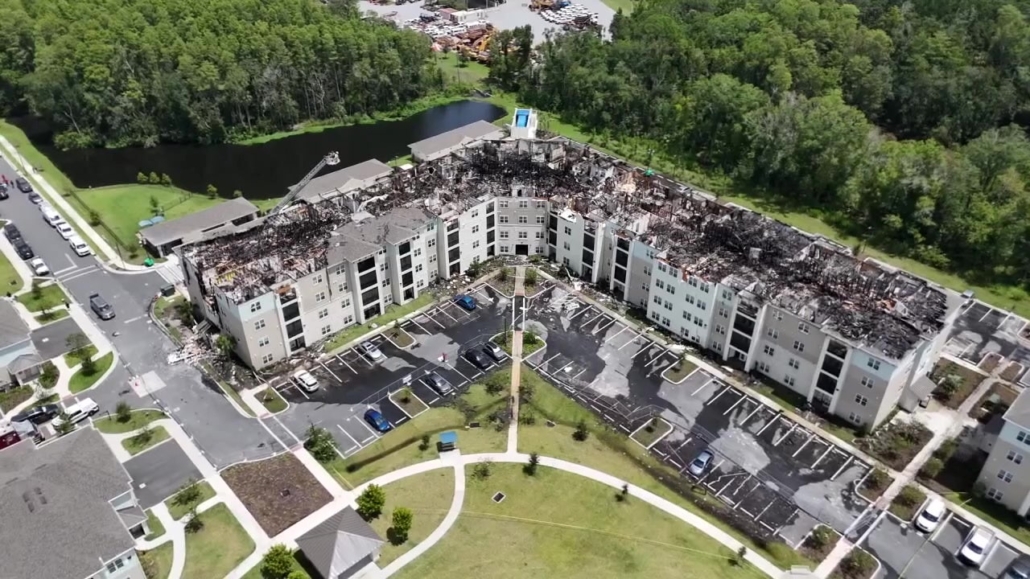
Cobalt Apartments, Wesley Chapel, August 20
Lightning hit the roof of Building 2 at about 2:26 in the afternoon. The fire started in the attic, above the sprinklers and above the smoke detectors. The strike also knocked out the building’s alarm panel, so roughly twenty minutes passed before anyone called 911.
The fire burned for about twelve hours. One hundred sixty-seven residents lost their homes, the county condemned the building, and people were told their belongings were “highly unlikely” to be recovered.
St. Petersburg Catholic High School, September 8
A strike hit the gym roof around 3:30 in the afternoon with the junior varsity volleyball team practicing inside. Everyone got out. More than 80 firefighters answered a three-alarm fire.
Authentix Suncoast, Brooksville, September 9
A strike to a 24-unit building started a fire between the first and second floors. Four units were damaged, and 34 people were displaced overnight.
Your house has a roof, an attic, and wiring running through the walls. The strike hits the highest point, the fire starts where nobody can see it, and by the time the smoke alarm in the hallway goes off, the attic has a head start. That is the pattern in an apartment building with a sprinkler system. In a single-family home with none, the fire has an even easier night.
The Cobalt building met code. Pasco County has said so. Lightning protection is not required on an apartment building in Florida, and it is not required on your house either. That gap is what this article is about.
Does homeowners insurance cover lightning strikes?
This is the question people search for more than any other after a storm, so here is the straight answer. Standard Florida homeowners policies list lightning as a covered peril, and a fire started by lightning is covered as a fire loss. That is the good news. The rest of the story:
- Your deductible still applies, and after the premium increases of the last few years, many Florida deductibles are not small.
- Electronics and appliances are where most lightning claims land, and whether you get replacement value or depreciated value depends on your policy.
- The claim follows you. A lightning fire claim on your record affects your renewal.
- Some insurers offer a credit for a lightning protection system certified under UL 96A. Not all do. Ask your agent before you assume either way.
The Insurance Information Institute reported this June that Florida led the country in 2025 with 5,136 lightning-related homeowners claims and roughly $186 million in insured losses. The average Florida claim came in near $36,000. Nationally, the average lightning claim rose 42.8 percent in one year, to $26,616.
Those numbers are low because when a strike causes a fire, the claim is filed as a fire loss and never counted as lightning at all. The same report recommends a professionally installed lightning protection system as one of the main ways a homeowner reduces that risk. That is the insurance industry talking, not us.
What lightning protection for homes actually includes
People picture a tall iron spike on a barn. A modern home system is closer to a plumbing job than a sculpture. Five parts, all specified by NFPA 780, the national standard for lightning protection:
Air terminals. The rods. On a house, they are small and low-profile, set along the ridge and at the corners of the roof. They give the strike a preferred point of contact that is not your shingles, your chimney, or your attic vent. Chuck told FOX 13 they range from about 6 to 20 feet depending on the application and can be roof-mounted or ground-mounted. On a typical home, they are the short end of that range.
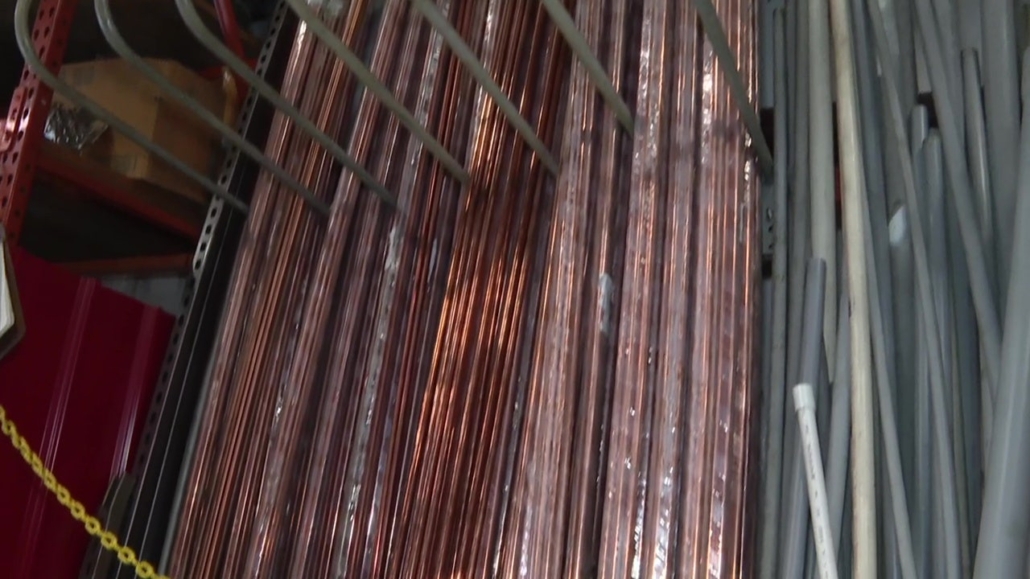
Conductors. Heavy copper or aluminum cable, the kind stacked in our warehouse in the photo above. It connects the air terminals and runs down the outside of the house to the ground. On a well-designed home system, the cable follows the architectural lines and most people standing in the driveway never notice it.
Grounding. Ground rods are driven into the earth and bonded to the conductors, so the strike has a low-resistance path into the ground instead of through your framing and your wiring. We cover grounding in more depth on its own page.
Bonding. Every large metal system in the house gets tied into the network: plumbing, gas line, HVAC, the electrical service. This is the part that stops a strike on the roof from jumping between systems inside the walls, which is how attic fires start.
Surge protection. Surge protective devices at the electrical panel clamp whatever energy does get into the wiring before it reaches your air conditioner, your appliances, and your electronics.
Depending on the system, the protected radius runs from roughly 180 to 380 feet, which on most residential lots covers the house, the garage, and the pool equipment.
Lightning rod installation cost for a house
There is no honest flat number, because the price follows the roof. A one-story ranch with a simple gable roof needs fewer air terminals and less conductor than a two-story home with a complex roofline, a metal chimney cap, and a detached garage. Height, nearby trees, and how many metal systems need bonding all move the figure.
What we can tell you is the order of magnitude Chuck gave FOX 13: it is inexpensive next to what it prevents. The average Florida lightning claim is around $36,000, and that is only the claims that get filed as lightning. We put together a full breakdown of how much a lightning protection system costs and what drives the price, and all three of our offices give estimates on residential work.
“Even when you’re sleeping”
Here is what Chuck said on camera, in full:
“I’m the type that, if it’s available to me, let me go ahead and put it on my house. It’s out there. It can keep your house safe from being damaged, even when you’re sleeping. It’s inexpensive, and there are people out here that do this for a living, strictly in Florida.”
The last line matters more than it sounds. Lightning protection is not a side job for a roofer or an electrician. It is designed and installed by specialists to NFPA 780, and the finished installation can be certified under UL 96A, the Underwriters Laboratories standard that verifies the work meets the code. That certificate is what your insurer and your inspector look for.
The street that called us
FOX 13 asked what has changed. The honest answer is that people are calling who never thought about lightning before.
Earlier this summer in St. Johns County, lightning struck a house and the fire nearly spread to the home next door. The neighbor called us. Then other homeowners on the same street called. Nobody on that street had lightning protection, and after watching a fire come within a few feet of their own roof, most of them wanted it.
That is what is happening across Florida as more people move here and neighborhoods fill in. The National Weather Service counts Florida as the lightning capital of the country year after year. In open country, the tallest thing around is a tree. In a subdivision, it is a roofline. Yours.
Commercial lightning protection: the same system, from Tropicana Field to your roof
Lightning protection is not limited to houses, and for most of our 40-plus years, commercial lightning protection was the bigger part of our work. Our systems are on hospitals, schools, data centers, and government buildings across the state, and on some of Tampa Bay’s best-known landmarks: Tropicana Field, where we installed the system after Hurricane Milton took the roof off, the Museum of Science and Industry, and the MIDFLORIDA Credit Union Amphitheatre.
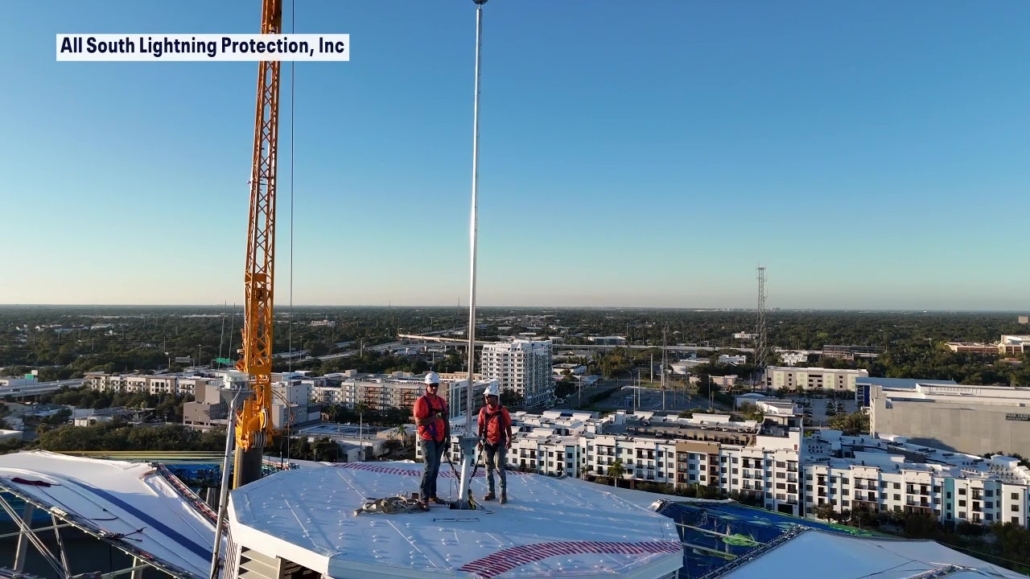
The engineering that protects a stadium is the engineering that protects a house. The system is smaller, the design is simpler, and the installation on a home usually takes a day or two. What does not change is the standard it is built to.
If you own or manage a commercial building, an apartment community, a school, or a church, the three fires above are your case study too. Pasco County’s commission chairman has already put lightning protection for commercial buildings on the table. We would rather you call before the code changes than after the fire.
Lightning protection near me: what to do this week
If you own a home in Florida, three steps in order:
- Put surge protection at the panel. Whole-house surge protection is the least expensive piece, and it protects everything plugged into the walls. It will not stop a fire, but it stops the electronics loss that shows up on most lightning claims.
- Have the house evaluated for a full lightning protection system. Roof shape, height, nearby trees, and the metal systems inside all factor into the design. This is a specialist’s conversation, not a checklist.
- Ask for NFPA 780 and UL 96A by name. If a contractor cannot tell you what those are, keep looking.
Frequently Asked Questions
Do lightning rods on a house attract lightning?
No. A lightning rod does not pull strikes toward your home. It gives a strike that was already going to hit the highest point on your property a safe place to land and a low-resistance path to the ground. Without a system, the strike lands on the roof anyway and finds its own path through the framing, the wiring, or the plumbing. That is the path that starts fires. Lightning rods on a house are the difference between a strike you read about in the morning and one you sleep through.
Does homeowners insurance cover lightning strikes in Florida?
Standard Florida homeowners policies list lightning as a covered peril, and a fire started by lightning is covered as a fire loss. Your deductible still applies, and how electronics and appliances are valued depends on your policy. A claim on your record also affects your renewal. Some insurers offer a credit for a lightning protection system certified under UL 96A, but not all do, so ask your agent directly. The Insurance Information Institute reports Florida led the country in lightning claims in 2025 with 5,136 claims and roughly $186 million in insured losses.
How much does lightning rod installation cost for a house?
It depends on the roof. A simple one-story gable roof needs fewer air terminals and less conductor cable than a two-story home with a complex roofline, a detached garage, and several metal systems to bond. Height and nearby trees also factor in. Every All South residential system is designed to the structure, and the Tampa, Jacksonville, and Sunrise offices all provide estimates. For the factors that move the price, see our breakdown of how much a lightning protection system costs.
How long does it take to install lightning protection on a home?
Most single-family homes take a day or two once the design is done. The crew mounts the air terminals along the ridge and corners, runs the conductor cable down the exterior, drives and bonds the ground rods, ties in the metal systems inside the house, and installs surge protection at the panel. The design step, which accounts for roof geometry and the surrounding site, happens before anyone climbs a ladder.
What should I ask a lightning protection installer?
Two things. Is the system designed to NFPA 780, the national standard for lightning protection? And can the finished installation be certified under UL 96A? A contractor who cannot answer both clearly is not a lightning protection specialist. The Lightning Protection Institute also lists certified installers if you want a second source.
Florida’s lightning season runs through October. The three buildings that burned in the last month had no lightning protection. The next storm is already on the calendar.
All South Lightning Protection installs residential and commercial lightning protection systems across Florida from offices in Tampa, Jacksonville, and Sunrise. To talk with us about protecting your home, contact the office nearest you and ask for a residential estimate.