Florida Lightning Statistics: The Hard Numbers Behind a Non-Optional Risk
Before a single insurance claim is filed or a piece of equipment fails, the exposure already exists. Florida’s lightning environment is the most severe in the United States — not by a small margin, but by a wide one. If you manage a commercial facility, school, hospital, data center, or any structure with people and equipment inside it, Florida lightning statistics aren’t background reading. They’re the business case for every protection decision you make. This post lays out the verified numbers, explains what they mean at the facility level, and connects them to the standards and systems that actually reduce risk.
Florida Is the Lightning Capital of the United States — Here’s the Data
The phrase “lightning capital” gets used loosely, but the National Weather Service data backs it up precisely. Florida records approximately 76 cloud-to-ground lightning flashes per square mile per year — the highest flash density of any state in the contiguous U.S. That translates to roughly 1.4 million cloud-to-ground strikes annually across the state.
For context, the national average flash density hovers around 20–25 flashes per square mile per year. Florida’s number is three times that. Parts of the I-4 corridor — running from Tampa through Orlando — consistently rank among the highest-density lightning zones on the continent. Central Florida’s geography, afternoon sea-breeze convergence patterns, and summer humidity create a near-daily convective cycle that produces thunderstorms with a reliability that forecasters can almost set a clock to.
Florida also logs more than 100 thunderstorm days per year in its most active regions. That’s not 100 storms — that’s 100 calendar days on which at least one thunderstorm occurs somewhere in the area. For a facility that operates 365 days a year, that figure means roughly one in three days carries meaningful lightning exposure.
What $2.6 Billion in Insurance Claims Actually Tells You
Raw strike counts are one thing. Financial exposure is another. Between 2021 and 2024, Florida generated more than 250,000 lightning-related insurance claims totaling over $2.6 billion in paid losses. The national average payout per lightning claim in 2024 sits at approximately $18,641 — but commercial claims routinely exceed that figure by an order of magnitude once you factor in HVAC controls, fire suppression panels, building automation systems, and IT infrastructure.
That $18,641 average is pulled down by residential claims. A single commercial strike event that takes out a building’s main electrical panel, a UPS system, and a server rack can easily reach six figures before the adjuster closes the file. Hospitals, schools, and data centers carry even higher exposure because their equipment is specialized, lead times for replacement parts are long, and operational downtime carries its own cost layer on top of the hardware loss.
Risk managers who treat lightning as a low-probability event are working with the wrong probability. In Florida, it’s a high-frequency event with variable severity — and that combination is exactly what structured protection systems are designed to address.
The Hidden Cost: Downtime and Cascade Failures
Insurance pays for damaged equipment. It doesn’t fully compensate for what happens while that equipment is offline. Data center operators routinely cite downtime costs of $5,000 to $10,000 per minute for Tier II and Tier III facilities. A lightning-induced power surge that trips a UPS, corrupts a storage array, or takes down a cooling system doesn’t need to cause a fire to be catastrophic — the cascade of secondary failures is often the real story.
The same logic applies to hospitals. A strike event that disrupts building automation, nurse-call systems, or medical imaging equipment in a facility that cannot evacuate patients mid-storm creates a patient safety exposure that no insurance policy fully resolves. That’s why lightning protection for healthcare facilities involves a layered approach — structural protection, grounding, and coordinated surge suppression working together.
Florida’s Thunderstorm Geography: Why Some Facilities Carry More Risk
Not all Florida locations face identical exposure. The state’s lightning activity is driven by two primary mechanisms: the Gulf-Atlantic sea-breeze convergence zone (which runs roughly along the I-4 corridor) and afternoon convective heating over the peninsula’s interior. The result is a geographic gradient that facility managers should understand.
The Tampa Bay area — including Hillsborough, Pinellas, and Pasco counties — sits directly in the convergence zone. Tampa itself averages around 83 thunderstorm days per year. The Orlando metro is comparable. South Florida, including Broward and Miami-Dade, sees slightly lower flash density but still far exceeds national averages, with intense afternoon storms common from May through October. Jacksonville and the northeast corridor experience fewer annual storm days than central Florida but still log flash densities well above the national mean.
Elevation matters too, though Florida’s flat topography means the relevant variable is usually roof height and structural exposure rather than terrain. A six-story commercial building in Brandon or a water tower in Riverview presents a very different risk profile than a single-story retail strip — and the Rolling Sphere Method defined in NFPA 780 exists precisely to model that exposure geometry accurately. The 150-foot rolling sphere replaced the old 45-degree cone-of-protection model because the cone consistently underestimated real-world strike attachment points on complex structures.
What the Standards Require — and Why Florida Enforces Them
Florida is one of the few states that explicitly requires NFPA 780 compliance for new commercial construction. The 2026 edition of NFPA 780 is the governing standard for lightning protection system design and installation, covering everything from air terminal placement to conductor sizing to grounding electrode requirements. It’s not advisory guidance — it’s the code basis for permit approval in Florida’s commercial construction pipeline.
UL 96A (14th edition, 2023) governs the installation of complete systems and provides the framework for UL Master Label certification. That certification doesn’t come from the contractor — Underwriters Laboratories inspects the installed system independently. The certificate expires every five years, which is why post-installation inspection and recertification are ongoing obligations, not one-time events. For risk managers and insurance underwriters, a current UL Master Label is the documentation that demonstrates a system was installed correctly and remains in compliance.
The grounding requirements deserve specific attention. Under NEC 250.106, a lightning protection grounding system must bond to the building’s electrical grounding system. Under NEC 250.60, lightning protection electrodes are maintained as a separate system but bonded to the building grounding electrode system to prevent dangerous potential differences. A ground bed resistance target of less than 25 ohms — with bonding connections at or below 1 ohm — is the practical benchmark. Systems that don’t meet that threshold create equipotential bonding failures that can cause sideflash inside the structure, which is exactly the failure mode the system is supposed to prevent.
Surge Protection Is Part of the System, Not a Separate Option
One of the most persistent misconceptions in commercial facility management is treating surge protection as an add-on rather than an integral component. NFPA 780 and Lightning Protection Institute guidelines both specify a three-tier SPD architecture: Type 1 devices at the service entrance, Type 2 devices at distribution panels, and Type 3 devices at point-of-use. All three tiers are required because each handles a different portion of the transient energy spectrum.
A power strip with a built-in surge protector is a Type 3 device. It provides point-of-use protection against small transients but offers essentially no protection against a direct-strike event or a high-energy surge entering through the service entrance. Facilities that rely on power strips as their primary surge strategy are not protected — they’re creating a false sense of security. Coordinated surge suppression designed to NFPA 780 and IEC 62305-4 standards is a different category of protection entirely.
Florida Lightning and the Sectors That Face the Highest Exposure
The Florida lightning statistics hit differently depending on what’s inside the building. Here’s how the risk profile breaks down across the sectors we work with most.
Schools and Educational Facilities
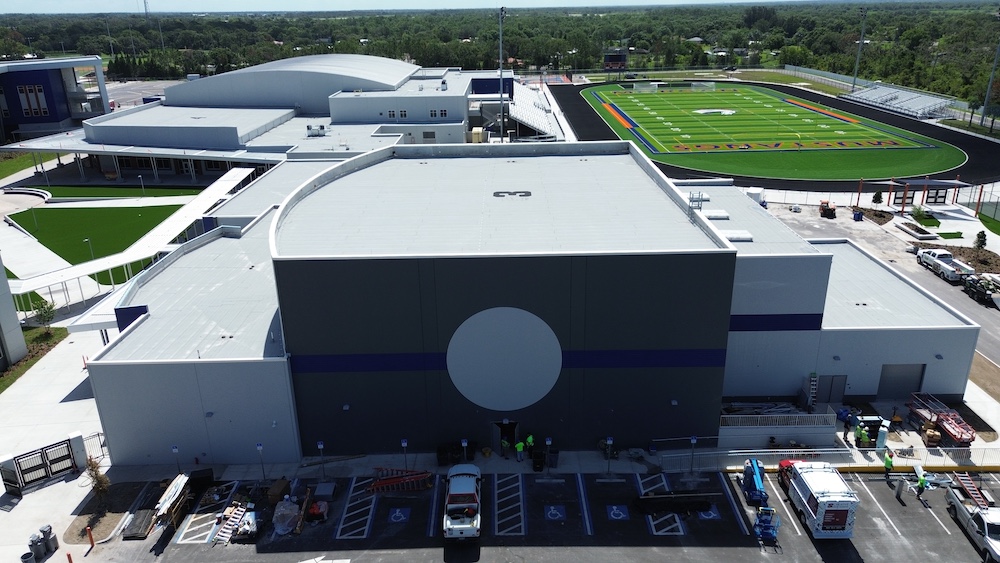
Florida law requires NFPA 780-compliant lightning protection for new school construction. That requirement exists because schools aggregate large numbers of people in structures that are often the tallest buildings in their immediate area, with extensive athletic fields and outdoor gathering spaces that create exposure during dismissal and extracurricular activities. Superintendents and facilities directors who manage older campuses should note that the law’s requirement for new construction doesn’t eliminate the duty-of-care obligation for existing buildings. Our education project portfolio includes installations at Floral City Elementary, Delores Parrot Middle, and Deep Creek Elementary, among others.
Healthcare Facilities
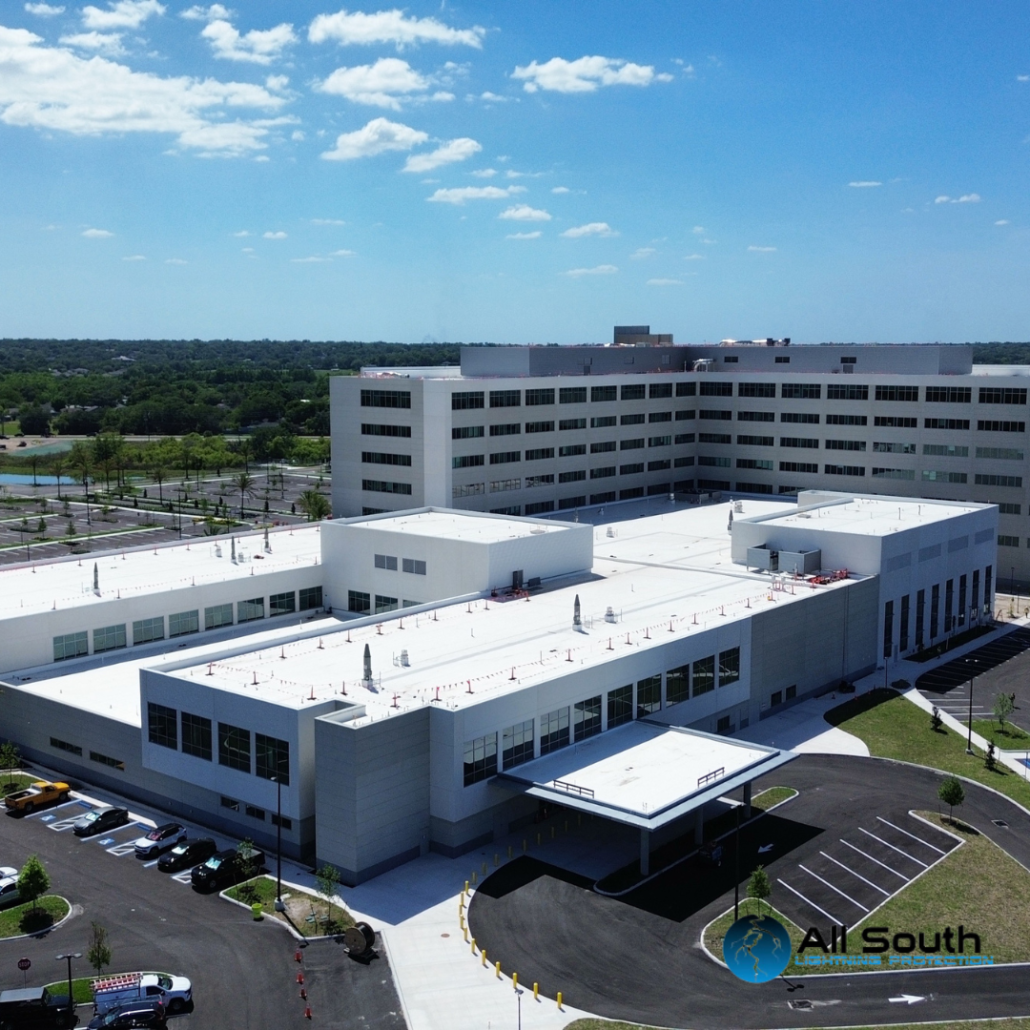
Hospitals operate under 42 CFR §482.15 emergency preparedness requirements and Joint Commission standards that treat power continuity as a patient safety issue. A lightning event that disrupts building systems in a facility that cannot safely evacuate patients isn’t just an equipment problem — it’s a regulatory and liability event. Tampa General Hospital’s helipad lightning protection is one example of how critical-use infrastructure requires site-specific engineering rather than generic system design.
Data Centers and IT Infrastructure
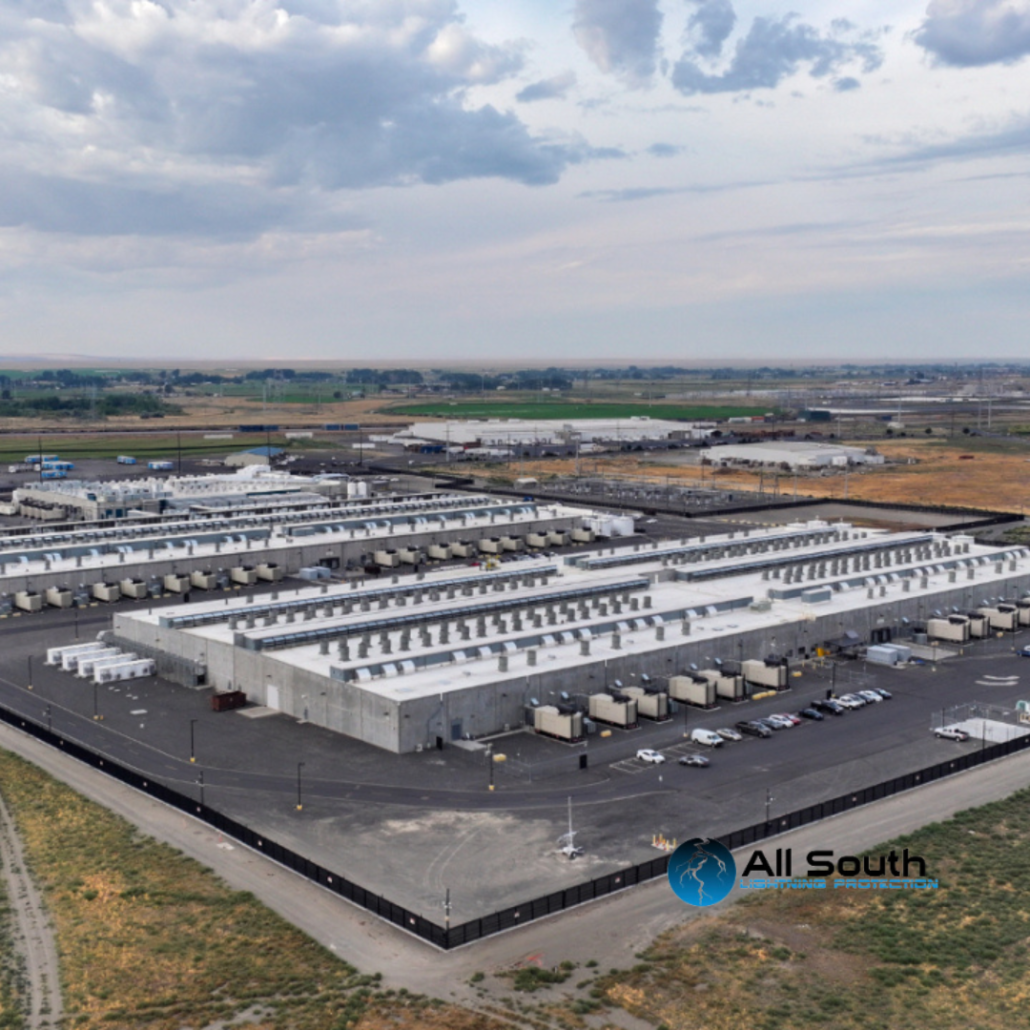
IEC 62305-4 defines the Lightning Protection Zone (LPZ) framework for electronic systems. Server rooms and data centers require LPZ 2 protection — meaning the electromagnetic environment inside the protected space must be controlled to a level that sensitive electronics can tolerate. That requires coordinated structural protection, shielding, and SPD coordination. The data center lightning protection requirements are more demanding than standard commercial construction, and the cost of getting it wrong — measured in downtime at $5,000–$10,000 per minute — makes the investment straightforward to justify.
Inspections: The Statistic Nobody Tracks Until It’s Too Late
A lightning protection system installed in 2010 and never inspected since is not a functioning system — it’s a liability. Conductors corrode. Ground connections loosen. Renovations sever bonding paths. The UL 96A five-year recertification cycle exists because systems degrade in service, and Florida’s salt air, humidity, and UV exposure accelerate that degradation faster than most other climates.
Post-storm inspections are equally important. A near-miss or partial strike can damage components without triggering an obvious failure. A visual inspection after a significant storm event — particularly one that involved a confirmed strike on or near the structure — is standard practice for any facility with a UL Master Label system. Our inspection services cover both scheduled recertification and post-event assessments, with documentation suitable for insurance and regulatory purposes.
Frequently Asked Questions
How does Florida’s lightning flash density compare to other high-risk states?
Florida’s 76 flashes per square mile per year is the highest in the contiguous U.S. The next-highest states — parts of the Gulf Coast in Louisiana, Mississippi, and Alabama — typically range from 50 to 65 flashes per square mile. Texas and Oklahoma see high strike counts due to sheer land area, but their flash density per square mile is lower than Florida’s. The combination of flash density, storm day frequency, and population density in Florida’s urban corridors makes it the highest-risk state for both human safety and property loss.
Does a lightning protection system prevent all lightning damage?
A properly designed and installed system — one that meets NFPA 780, carries a UL Master Label, and includes coordinated surge suppression at all three SPD tiers — intercepts direct strikes, safely conducts the energy to ground, and limits transient overvoltages on electrical and data systems. It doesn’t make a building immune to every possible lightning-related event, but it reduces the probability of structural damage, fire, and equipment loss to a level that is actuarially meaningful. Insurance carriers recognize this: facilities with certified systems often qualify for premium reductions of up to approximately 18%.
What’s the difference between a surge protector and a lightning protection system?
A surge protector — including the power strip variety — is a Type 3 SPD designed to handle small transient voltages at the point of use. It provides no meaningful protection against a direct strike or a high-energy surge entering through the service entrance. A lightning protection system is a complete structural installation: air terminals, down conductors, a grounding electrode system, equipotential bonding, and coordinated SPDs at all three tiers (Type 1, 2, and 3). The two are not interchangeable. A power strip is not a substitute for a system designed to NFPA 780 standards.
How often does a commercial lightning protection system need to be inspected?
UL 96A requires recertification every five years for systems carrying a UL Master Label. Beyond that scheduled cycle, post-storm inspections are recommended after any event involving a confirmed or suspected strike on or near the structure. Florida’s environment — salt air, humidity, UV exposure, and frequent storm activity — accelerates component degradation, so the five-year cycle is a minimum, not a ceiling. Facilities undergoing renovation or addition work should also schedule an inspection, since construction activity frequently disrupts bonding connections and conductor paths without the contractor recognizing the impact on the LP system.
Is lightning protection required by Florida law for commercial buildings?
Florida requires NFPA 780-compliant lightning protection for new school construction by statute. For other commercial construction, the requirement flows through the Florida Building Code and local AHJ (Authority Having Jurisdiction) interpretation, which increasingly references NFPA 780 as the applicable standard. Beyond code minimums, insurance requirements, Joint Commission standards for healthcare, and lender requirements for certain property types create additional compliance drivers. The practical answer for most commercial facility managers is that the combination of code, insurance, and duty-of-care obligations makes a certified system the default expectation rather than an optional upgrade.
The Numbers Point in One Direction
Seventy-six flashes per square mile. 1.4 million annual strikes. $2.6 billion in paid claims over four years. More than 100 thunderstorm days per year in Florida’s most active regions. These aren’t alarming statistics designed to sell something — they’re the documented operating environment for every commercial facility in this state. The question isn’t whether your building will face lightning exposure. It’s whether the systems protecting it were designed, installed, and maintained to handle that exposure when it arrives.
All South Lightning Protection has been designing and installing certified systems across Florida for more than 40 years — from Tampa General Hospital’s helipad to the Tampa Convention Center’s Faraday installation to school campuses across the state. If your facility doesn’t have a current UL Master Label, hasn’t been inspected in the last five years, or is heading into a construction or renovation phase, now is the right time to get a professional assessment on the calendar. Schedule a site assessment with our team and get a clear picture of where your system stands before the next storm season.