Lightning Detection Technology in Florida: What Sports Venues Need to Know Now

TL;DR: When a lightning bolt kills or injures a spectator at an outdoor venue, the legal exposure doesn’t hinge on whether the storm was unusual; it hinges on whether the facility had a documented warning protocol and acted on it. Florida logs roughly 76 cloud-to-ground flashes per square mile per year, the highest density of any state in the country, and sports venues sit squarely in the crosshairs.
The good news is that lightning detection technology has advanced far beyond a simple horn-and-flag system. Real-time ground-based sensor networks, predictive atmospheric algorithms, and direct integration with building management systems (BMS) now give venue operators a genuine decision-support tool — not just a liability shield. This post breaks down where the technology stands, what’s coming next, and how Florida venues can build detection into a complete, NFPA 780-compliant protection strategy.
Why Florida Venues Face a Different Risk Profile Than the Rest of the Country
Florida’s lightning environment isn’t just statistically worse, it’s structurally different. The peninsula’s geography creates a daily sea-breeze convergence zone that fires convective storms with very little warning, often in under 20 minutes from clear sky to first strike. The National Weather Service documents more than 100 thunderstorm days per year in parts of central Florida, and the state accounts for roughly 1.4 million cloud-to-ground strikes annually. For a venue like a stadium or an outdoor amphitheater, that means the threat window is compressed in ways that make traditional radar-watching inadequate.
Radar shows precipitation, not electrical activity. A storm can produce dangerous lightning before it produces rain visible on a standard Doppler display. That gap between what radar shows and when the first strike actually hits is exactly where modern lightning detection technology earns its value. Ground-based sensor networks detect the electromagnetic signature of lightning discharges in real time, with no precipitation required. Some systems also monitor atmospheric electric field (E-field) buildup, flagging dangerous conditions before the first bolt ever forms.
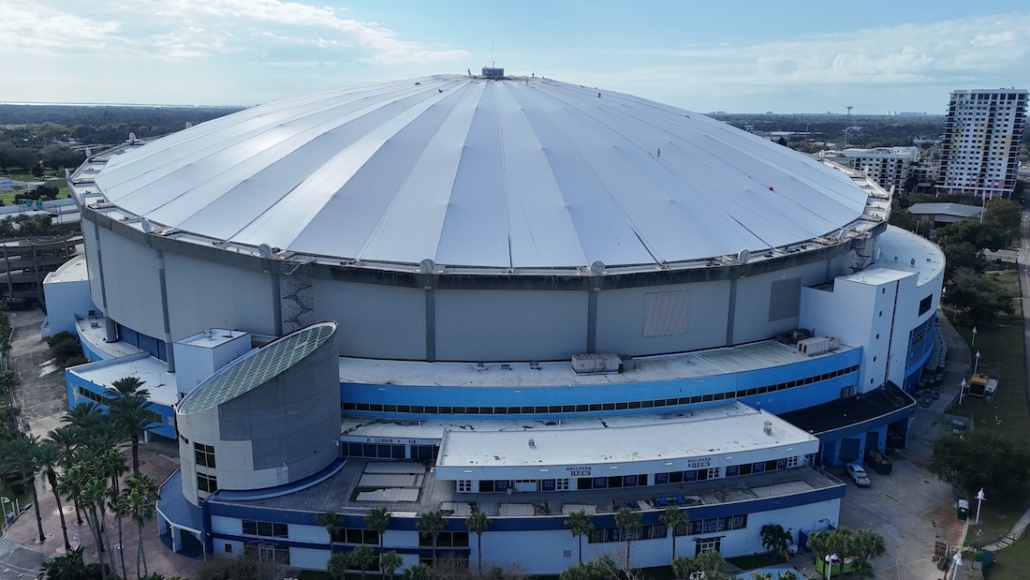
Venues like Tropicana Field, Raymond James Stadium, Amalie Arena in Tampa, and TIAA Bank Field in Jacksonville manage tens of thousands of occupants during events. Evacuation of a 65,000-seat stadium takes time — time that a compressed Florida storm cycle doesn’t always provide. Detection technology that extends the warning window by even 10–15 minutes is operationally significant. It’s the difference between an orderly evacuation and a dangerous scramble.
How Modern Lightning Detection Systems Actually Work
Ground-Based Sensor Networks
The backbone of commercial lightning detection is a network of ground-based sensors that triangulate the electromagnetic pulse (EMP) produced by each lightning discharge. National networks operated by companies like Vaisala and Earth Networks cover the continental U.S. with sub-kilometer location accuracy and detection efficiencies above 95% for cloud-to-ground strokes. Venue operators subscribe to these networks through software platforms that deliver strike data — location, polarity, peak current — with latency measured in seconds, not minutes.
What’s changed in the last five years is the density of these networks and the quality of the analytics layer on top of them. Earlier systems gave you a dot on a map. Current platforms give you a configurable warning radius (typically 8 miles for initial alert, 3 miles for immediate action), trend analysis showing whether storm cells are approaching or retreating, and automated alert delivery via app, SMS, PA integration, or direct BMS trigger. The Lightning Protection Institute recommends that venue emergency action plans specify both the detection technology in use and the decision thresholds tied to it — not just a generic “when you see lightning” instruction.
Atmospheric Electric Field Monitoring
Electric field mills (E-field sensors) measure the electrostatic field at ground level. As a thunderstorm develops, the field strength increases measurably, often 15 to 30 minutes before the first lightning discharge. For high-occupancy venues where evacuation lead time is critical, E-field monitoring adds a predictive layer that pure strike-detection networks can’t provide. A field mill mounted on a venue roof or light tower feeds data to the same software platform, and when the field crosses a defined threshold, the system flags an elevated-risk condition even before the first bolt.
This isn’t theoretical. Several major league sports organizations have deployed E-field sensors at their facilities specifically to extend the warning window. The technology is mature, the sensors are low-maintenance, and the cost is modest relative to the liability exposure of a delayed evacuation. For Florida venues operating in a compressed-storm environment, E-field monitoring is worth serious consideration as a complement to network-based detection.
Predictive Algorithms and Machine Learning
The newest generation of detection platforms layers machine learning models over historical strike data, real-time sensor feeds, and numerical weather prediction (NWP) output. These models don’t just tell you where lightning is; they estimate where it’s going and when. Probability-of-lightning forecasts at 15-minute intervals, storm-cell tracking with projected path and intensity, and automated “all-clear” determinations (the 30-minute rule from last strike, codified in most venue protocols) are now standard features in enterprise-grade platforms.
For a facility manager running a multi-venue portfolio across Tampa, Jacksonville, and Broward County, this means a single dashboard can monitor all sites simultaneously, with automated escalation protocols that don’t depend on a staff member watching a radar screen. That’s a meaningful operational improvement, and it’s documentable, which matters when a risk manager or insurer asks for evidence of due diligence.
Integrating Lightning Detection with Building Management Systems
Detection is only as good as the response it triggers. The most significant operational shift in venue lightning safety over the last decade isn’t the sensors themselves; it’s the integration of detection outputs with the building management systems that control lighting, PA, access control, and HVAC. When a lightning warning crosses a defined threshold, a properly integrated system can automatically activate PA announcements, illuminate evacuation signage, lock field-access gates, and notify security staff — without requiring a human to initiate each step.
BMS integration follows a straightforward architecture: the detection platform outputs an alert via API or dry-contact relay to the BMS controller, which executes a pre-programmed response sequence. The venue’s emergency action plan defines the thresholds and the response steps; the technology executes them consistently. This removes the single biggest failure mode in venue lightning safety: human hesitation. Staff don’t have to make a judgment call under pressure; the system makes the call based on pre-approved criteria.
For venues pursuing NFPA 780 compliance or UL 96A certification, documented BMS integration also strengthens the paper trail. A certified lightning protection system combined with a documented, technology-driven emergency action plan is a defensible position. A post-storm incident review that shows automated alerts were issued, PA announcements were triggered, and field access was locked, all with timestamps, is a very different conversation than one that relies on “the staff saw the storm coming.”
What NFPA 780 and UL 96A Actually Require — and Where Detection Fits
It’s worth being precise here, because there’s a common misconception: NFPA 780 governs the physical lightning protection system air terminals, down conductors, grounding electrode system, equipotential bonding, and surge protective devices. It does not mandate a specific lightning detection technology. What it does require is that a complete system be designed and installed to protect the structure and its occupants from the effects of a direct strike.
Detection technology operates in a complementary layer; it’s the warning system that gives occupants time to reach the protection the physical system provides. The Underwriters Laboratories UL 96A certification process (14th edition, 2023) covers installation quality and system completeness; a UL-certified system recertified every five years is the gold standard for demonstrating that the physical protection is in place. Detection and warning protocols are addressed in venue emergency action plans, which are increasingly required by event sanctioning bodies, insurers, and state regulators.
For Florida venues, the practical compliance picture looks like this: a UL 96A-certified physical lightning protection system handles the direct-strike risk to the structure and its electrical infrastructure. A real-time detection platform with BMS integration handles the occupant-safety warning function. Surge protective devices — Type 1 at the service entrance, Type 2 at distribution panels, Type 3 at point-of-use protect electronics and equipment from transient overvoltages. All three layers work together; none of them substitutes for the others.
Our work at sports and entertainment venues across Florida — including Tropicana Field and Zoo Tampa consistently shows that facilities with all three layers in place have both better safety outcomes and stronger positions with their insurers. That’s not a coincidence.
The ROI Case for Advanced Detection at Florida Venues
Florida insurers paid out more than $2.6 billion in lightning claims between 2021 and 2024, with the national average claim running $18,641 in 2024. For a venue, a single lightning-related incident, whether it’s equipment damage, a guest injury, or an event cancellation, can dwarf those averages. The liability exposure from a documented failure to warn is in a different category entirely.
The ROI calculation for detection technology is straightforward. Enterprise-grade lightning detection subscriptions for a single venue typically run $2,000–$8,000 per year, depending on features and integration complexity. E-field sensor hardware adds a one-time cost in the $5,000–$15,000 range. BMS integration is a project cost that varies by system complexity. Set against the cost of a single serious incident, legal fees, settlement, reputational damage, event cancellation insurance claims, the math does not add up.
There’s also an operational upside that’s easy to overlook: accurate all-clear determinations. Venues that rely on conservative manual protocols often extend weather delays longer than necessary, frustrating fans and costing revenue. A detection platform with a documented 30-minute all-clear algorithm gives operations staff a defensible basis for resuming events as soon as it’s genuinely safe, not just when someone feels comfortable making the call.
For a deeper look at how detection integrates with a complete protection strategy, see our overview of commercial lightning protection systems and our post on lightning protection at Tampa landmark venues.
What’s Coming Next: The Near-Term Technology Roadmap
Three developments are worth watching over the next three to five years. First, total lightning detection systems that detect intracloud (IC) discharges, not just cloud-to-ground (CG) strokes, are becoming more accessible at the venue level. IC activity typically precedes CG activity, so detecting it extends the warning window further. National networks already capture IC data; the question is how that data gets surfaced in venue-level platforms.
Second, drone-based inspection and sensor deployment are beginning to change how venues maintain and verify their physical protection systems. A drone with a thermal camera can identify corrosion at conductor connections or grounding electrode issues that would otherwise require scaffolding. This isn’t detection in the traditional sense, but it’s part of the same technology ecosystem — using real-time data to maintain system integrity rather than waiting for a five-year inspection cycle to surface a problem.
Third, AI-driven hyperlocal forecasting is narrowing the gap between regional NWP models and venue-specific conditions. Models trained on years of local strike data can now produce 30-minute lightning probability forecasts at sub-kilometer resolution. For a venue operations team making real-time decisions about event timing, that’s a qualitatively different tool than a county-level radar loop.
The OSHA general duty clause already creates an obligation to protect workers from recognized hazards — and lightning at an outdoor Florida venue is unambiguously a recognized hazard. As detection technology becomes more capable and more affordable, the standard of care for venue operators will rise accordingly. Facilities that adopt these tools now are ahead of that curve; those that don’t will find themselves explaining the gap.
Frequently Asked Questions
Does a lightning detection system replace a physical lightning protection system?
No, and this distinction matters. A lightning detection system is a warning tool; it tells you a threat is approaching so occupants can reach safety. A physical lightning protection system, including air terminals, down conductors, grounding electrodes, bonding, and surge protective devices installed to NFPA 780 and certified under UL 96A, is what protects the structure and its electrical infrastructure when a strike occurs. You need both. Detection without a certified physical system leaves your building and equipment exposed. A physical system without detection leaves your occupants without adequate warning time, which in Florida’s compressed-storm environment is a serious gap.
What warning radius should a Florida sports venue use?
Most venue emergency action plans use an 8-mile radius for initial alert (suspend outdoor activities, begin moving spectators toward shelter) and a 3-mile radius for immediate action (clear all outdoor areas). These thresholds are consistent with guidance from the National Weather Service and the Lightning Protection Institute. In Florida, where storms can move at 20–30 mph and develop rapidly, the 8-mile initial threshold is not conservative — it’s appropriate. Some venues with large outdoor footprints or slow evacuation capacity use a 10-mile initial threshold. The key is that the threshold is documented in the emergency action plan and consistently applied, not adjusted based on event circumstances.
How does BMS integration with lightning detection actually work in practice?
The detection platform — whether it’s a cloud-based subscription service or an on-site sensor system — outputs an alert when strike activity crosses a defined threshold. That alert is delivered to the BMS via API, MQTT protocol, or a dry-contact relay signal, depending on the BMS architecture. The BMS then executes a pre-programmed response sequence: PA announcements, evacuation lighting, gate locks, and security notifications. The entire sequence can execute in under 60 seconds from the alert trigger. The venue’s IT or facilities team programs the response logic; the detection vendor provides the alert output. Integration complexity varies by BMS platform, but most modern systems support it without custom hardware.
How often should a venue’s lightning protection system be inspected?
UL 96A requires recertification every five years for systems carrying a UL Master Label. Beyond that cycle, NFPA 780 recommends inspection after any direct strike, after significant construction or renovation that could affect conductor routing or grounding, and after severe weather events. For Florida venues that see 100+ thunderstorm days per year, an annual visual inspection of air terminals, conductor connections, and grounding electrode access points is a reasonable baseline between formal recertifications. Post-storm inspections are particularly important — a strike that doesn’t cause visible damage can still degrade grounding electrode resistance or damage surge protective devices that need replacement before the next event.
Can lightning detection data be used to support insurance claims or reduce premiums?
Yes, on both counts. Timestamped detection logs showing that a warning was issued, that the venue responded according to its emergency action plan, and that the all-clear was given only after the 30-minute window elapsed are valuable documentation in any post-incident review. Several Florida insurers now ask specifically about lightning detection and warning protocols during underwriting — facilities with documented systems and EAPs in place have reported premium reductions in the range of 10–18%. The data also supports claims by establishing the timeline of events, which matters when equipment damage or business interruption losses are being assessed.
Build the Complete Picture Before the Next Storm Season
Detection technology has genuinely changed what’s possible for Florida venue operators — longer warning windows, automated response protocols, defensible documentation, and better all-clear decisions. But detection is one layer of a three-layer system. The physical lightning protection infrastructure certified under UL 96A, the surge protective devices protecting your electronics and scoreboard systems, and the detection and warning platform all have to work together. A gap in any layer is a gap in your protection.
All South Lightning Protection has been designing and installing complete systems at Florida sports and entertainment venues for more than 40 years — from Tropicana Field to Zoo Tampa to PGA facilities across the state. We provide CAD-engineered, permit-ready designs, UL 96A-certified installations, and post-installation inspections that keep your certification current. If your venue’s lightning protection system hasn’t been reviewed recently, or if you’re planning a new facility or major renovation, schedule a site assessment before the next storm season begins. The window to get ahead of it is now.
Request a site assessment from All South Lightning Protection — we’ll evaluate your current system, identify detection integration opportunities, and give you a clear picture of where your protection stands.